
The Mouth Is Not a Separate Organ: What Every Dental Practitioner Needs to Know About the Oral-Systemic Connection
By Frances K. Horning RDH BRDH HIAOMT | Integrative Perio Solutions
Somewhere along the way, dentistry got separated from medicine. The mouth became a specialty — a zone carved off from the rest of the body, treated in isolation, billed separately, and often thought about separately too.
It was never biologically accurate. And the research has been catching up to what integrative and biological practitioners have understood for decades: what happens in the mouth does not stay in the mouth.
This article is written for dental practitioners — hygienists and dentists — who want to understand the oral-systemic connection not as a marketing talking point, but as a clinical framework that changes how you see every patient who sits in your chair.
What Is the Oral-Systemic Connection?
The oral-systemic connection refers to the bidirectional relationship between oral health and the health of the rest of the body. It is not a one-way street. Systemic conditions can manifest in the mouth, and oral disease can contribute to — or worsen — systemic conditions elsewhere.
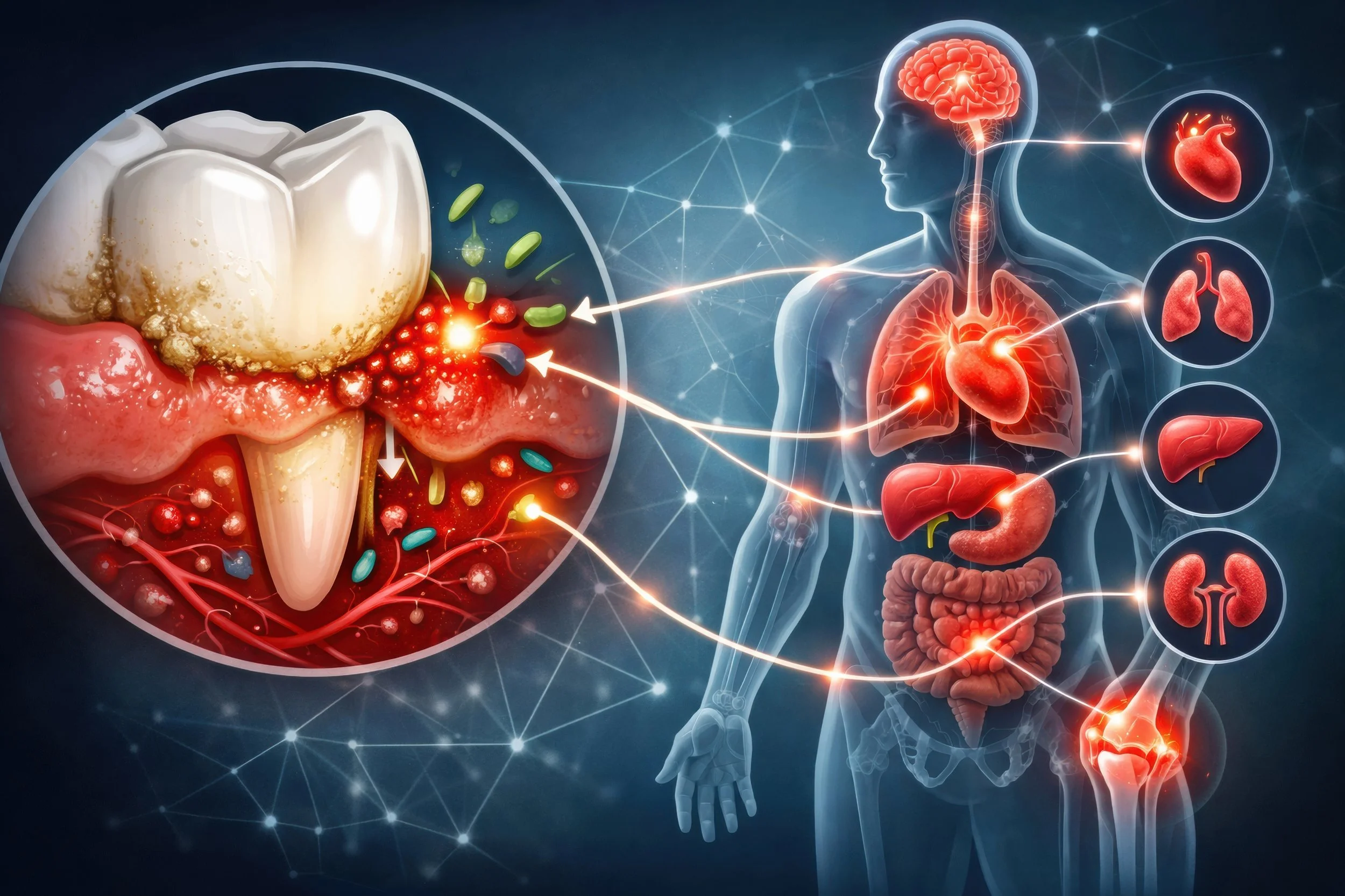
At the center of this relationship is inflammation. Periodontal disease is an inflammatory condition driven by a dysbiotic subgingival microbiome. When pathogenic bacteria proliferate in the sulcular environment, they trigger a local immune response. But that response does not stay local. Inflammatory mediators — cytokines, interleukins, prostaglandins — enter the bloodstream. Bacteria and their endotoxins can too.
The downstream effects of that systemic bacterial and inflammatory load are what connect the mouth to the rest of the body.
The inflammatory mediators generated by periodontal disease do not respect the boundaries of the gingival sulcus. They travel. And where they go matters.
The Conditions Linked to Periodontal Disease
The body of research connecting periodontal disease to systemic conditions has grown substantially over the past two decades. Here is a practitioner-level overview of the associations that are best supported by evidence:
Cardiovascular Disease
Periodontal pathogens — particularly Porphyromonas gingivalis — have been identified in atherosclerotic plaques. The proposed mechanisms include direct bacterial invasion of endothelial cells, stimulation of platelet aggregation, and the contribution of systemic inflammatory burden to arterial inflammation. People with periodontal disease have a measurably higher risk of heart disease and stroke.
Diabetes
The relationship between periodontal disease and diabetes is one of the most thoroughly studied in oral-systemic research. Diabetes increases susceptibility to periodontal infection by impairing immune response and altering the microbiome. In the other direction, chronic periodontal inflammation contributes to insulin resistance and makes glycemic control harder. Treating periodontal disease has been shown in multiple studies to improve HbA1c levels — a clinical outcome that should be part of how we talk about the value of periodontal therapy.
Adverse Pregnancy Outcomes
Periodontal disease during pregnancy is associated with preterm birth and low birth weight. The mechanism is thought to involve periodontal pathogens reaching the placenta via the bloodstream and triggering inflammatory responses that initiate premature labor. For pregnant patients, periodontal assessment is not optional — it is essential.
Respiratory Disease
Oral bacteria aspirated into the lungs contribute to pneumonia, particularly in elderly and immunocompromised patients. Research also supports associations between periodontal disease and chronic obstructive pulmonary disease (COPD). The oral cavity is the gateway to the respiratory tract — a dysbiotic oral microbiome is a respiratory risk.
Alzheimer's Disease and Cognitive Decline
This is an area of rapidly emerging research. Porphyromonas gingivalis and its toxic enzymes, called gingipains, have been detected in the brains of Alzheimer's patients, and animal studies have demonstrated that oral infection with P. gingivalis can lead to neuroinflammation. The research does not yet establish definitive causation, but the association is significant enough that it belongs in every practitioner's clinical awareness.
Why Conventional Treatment Is Not Enough
Conventional periodontal therapy — scaling and root planing, maintenance, antimicrobial rinses — manages the disease. For many patients, it manages it adequately. But management is not the same as resolution, and for patients with significant systemic comorbidities, adequate management may not be good enough.
Biological dentistry approaches periodontal disease differently. Rather than treating symptoms, the goal is to understand and address the underlying dysbiosis — the specific pathogens driving the inflammatory response — and support the conditions under which a healthy microbiome can re-establish itself.
This requires different tools and a different way of thinking about the disease process.
Treating periodontal disease without identifying what is in the biofilm is like prescribing antibiotics without knowing what you are treating. You may get lucky. Or you may miss entirely.
The Role of Phase-Contrast Microscopy
Phase-contrast microscopy is one of the most underutilized tools in biological periodontal care. It allows the clinician to view a patient's live subgingival biofilm sample — spirochetes, amoeba, cocci, motile rods — in real time, chairside, during the appointment.
The clinical value is twofold. First, it gives the practitioner actual pathogen data. Rather than treating every periodontitis patient with the same protocol, microscopy allows treatment to be customized based on what is actually present in that patient's sulcus. Spirochetes require a different approach than predominantly coccoid flora. Entamoeba gingivalis, a parasitic organism present in a significant portion of periodontitis patients, requires a different conversation entirely.
Second — and this is the piece that changes practices — it transforms patient education. When a patient can watch their own spirochetes moving on the screen in front of them, the abstract concept of gum disease becomes viscerally real. Treatment acceptance follows. Not because you talked them into it, but because they saw it themselves.
The Role of Ozone Therapy
Medical-grade ozone (O₃) is a powerful antimicrobial agent with a decades-long safety record in both medicine and dentistry. In the context of the oral-systemic connection, ozone therapy is particularly valuable because it addresses the pathogenic bacterial burden at the source — in the sulcular environment — without introducing the disruption to the broader microbiome that systemic antibiotics can cause.
In periodontal therapy, ozonated water and ozonated oils can reach deep into sulcular tissues, reducing pathogenic load and promoting tissue healing. Used as an adjunct to scaling and root planing, ozone consistently enhances outcomes. Used in maintenance, it supports the long-term microbiome stability that prevents disease recurrence.
Beyond periodontal applications, ozone arrests early carious lesions, decontaminates operative sites, and reduces cross-contamination risk — making it one of the most versatile additions any practice can make.
What This Means for Your Practice
The oral-systemic connection is not a niche concept anymore. Patients are arriving with more systemic health awareness than ever before. They are asking questions. They are seeking practitioners who understand that their mouth is part of their body — not a separate system maintained independently of everything else.
Practices that can speak to this connection fluently, that have the tools to assess and address the underlying drivers of oral disease, and that treat the patient as a whole person are the practices that will grow in the years ahead.
That means investing in the knowledge and the tools. It means training your team to see periodontal disease through a biological lens. It means being able to show a patient what is living in their biofilm, explain what it means for their systemic health, and offer a treatment protocol that addresses the cause — not just the chart findings.
For dental practitioners who want to build that capacity, here is where to start:
• Learn the oral-systemic research well enough to discuss it confidently with patients and physicians
• Assess the subgingival microbiome — through microscopy, salivary testing, or both — rather than treating all periodontal disease identically
• Explore biological adjuncts: ozone, laser therapy, evidence-based supplementation, pH management
• Treat the patient systemically — nutritional status, gut health, stress, and sleep all influence oral microbiome health and healing capacity
• Connect with a community of biological practitioners and keep learning
A Final Thought
The mouth is not a separate organ. It never was. The more clearly we see that — as practitioners, as a profession — the better care we will deliver and the greater difference we will make in the lives of our patients.
The research is there. The tools are available. The training exists. What biological dentistry asks of us is the willingness to look at the whole picture.
About the Author
Frances K. Horning RDH BRDH HIAOMT is a Certified and Accredited Biological Dental Hygienist, international speaker, coach, and the founder of Integrative Perio Solutions LLC and Hygiene Naturally. With more than 40 years of clinical experience, she provides on-site microscopy and ozone therapy training for dental teams and one-on-one coaching for practitioners integrating biological dentistry into their practice.
info@integrativeperiosolutions.com | (973) 339-7790 | integrativeperiosolutions.com